Monday, March 19, 2012

Fiction vs Non-Fiction How Do You Find A Balance In Your Classroom?

Once upon a time, there was a teacher who had a magic clock.  Everyday, she would carefully take the polished brass clock down from the classroom wall and whisper the secret words (they are secret...so no, I am not telling them to you)  Gently, she would hang the clock back on the wall before her students arrived for the day.  This clock adjusted time during the school day...giving her exactly the right amount of time she needed to complete all of her activities, and still send the students home promptly at the end of the day.   Don't we all wish that we had a magic clock?  But, we don't, so the struggle begins to figure out how to include time in our teaching day for extended reading of fiction and non-fiction content materials while still meeting all the other content standards we are responsible for.

Here is my secret for "time stretching".
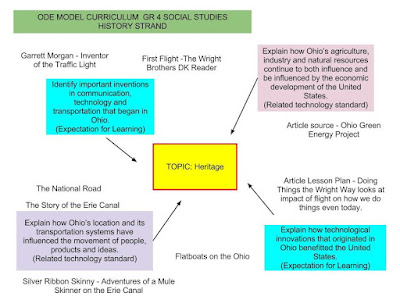
First, begin to plan your units on a web rather than a linear unit plan.  Put your main theme in the middle. Around it add specific content area standards you will address in the unit. From there, look at ways to integrate rich reading experiences. This may include finding a fiction book that has a theme, setting, plot line or character that connects to your content standards.  Then, look beyond your textbooks for content based textual reading for your students.  Sources include websites, e-zines, traditional magazines, and Infohio Gale Data bases.   Use a combination of reading strategies to expose students to the broadest range of materials.  I used jigsaw reading, providing a selection of 4-5 articles on a similar topic.  Students worked out of a "home group" with each student choosing a different article.  They then grouped with students who had read the same article to talk about key points and discuss questions or ideas they had while reading. They get back together with their" home group" to each share again.  This encourages Close Reading.  What other reading strategies can you think of to use with your class?  You can even extend the web planning idea to include related standards for other content areas.  I worked with the English teacher on my team to plan an integrated science unit on genetics around the novel Ghost Boy by Ian Lawrence.  The lead character has Albanism. The supporting characters, members of a circus freak show, exhibit a variety of other genetic disorders. The novel was a good starting point for lessons on genetic mutation. In addition, we looked at biodiversity and ethics.  The ELA teacher focused on the strong character development, identifying plot conflict and descriptive language.  The unit also included a research project that covered standards for ELA and science. Students were given credit in both of our classes.

Here is a sample of a unit web using a 4th grade Social Studies Topic - Heritage.  The book and article resources surround the colored standards.

Resources:
Article Resources

Tuesday, March 13, 2012

Text Complexity ...Is It In the Stars?

Deep down I am a science girl with a passion for reading.  I have surrounded myself with books of all lengths, genres and points of view.  I read blogs, magazines, news articles and...when there is nothing else, cereal boxes.   Tonight, as I stood outside on my front porch, telescope focused on Jupiter and Venus, I thought about how the reading that students do in a standard school day - worksheets, chapters in a textbook, an occasional news article, a chapter in a novel is very much like looking at the night sky with the naked eye.  You see a few bright stars, maybe a familiar constellation, the moon and not much else.  This is especially true in the city where lights around you block all but the brightest stars from view. People who grow up never experiencing the night sky in the country or through a telescope have a very limited exposure to all the millions of stars and galaxies there really are in the night sky.  Students who have not learned close reading strategies and students who are given less complex reading materials may only focus on obvious, surface level ideas and limited vocabulary words.  They miss the opportunity to wrestle with more sophisticated ideas, connect content to existing background knowledge , learn new vocabulary and make new insights into material. Kelly Gallagher, in his book Readicide, shares some informal research he did with an average high school class.  He asked them to track how much time they spent reading in a school day.  When he tabulated the results, he found that even his honor track students were actively reading on average 17 minutes during a 6 hour day. 

Just like I can use my telescope to focus in on an unfamiliar star or Jupiter and 4 of its moons in orbit around it, I can give my students reading material at a higher level of text complexity that challenges them to read and comprehend new words or find familiar words in a new context.  I can share reading materials that challenge them to expand their world view, test their existing beliefs, or build background knowledge that they may not be exposed to in their daily life.

What is text complexity?  It is a combination of vocabulary use (tier 1, tier 2 and tier 3 words), sentence complexity, content, knowledge demands and matching the reader to text and task

How can I learn more about text complexity?
Common Core Shift 3 - Staircase of Complexity   (NY Engage website) Video and resource links
Understand Lexile As A Measure of Text Complexity
Common Core Appendix A - with definitions of the 3 components of text complexity
Ohio Resource Center - links for how to evaluate text complexity
Engage NY Rubrics for Qualitative Analysis of Text Complexity and Determining Appropriate Task to Text Complexity balance
Minding the Gap - Focusing on Vocabulary  Char's prior blog focusing on Vocabulary
Reversing Readicide (ASCD EdLeadership Article) Kelly Gallagher


Tuesday, February 28, 2012

How Do We Teach Readers to Read For A Purpose?


I am reading a number of books right now.  The Snow Child, by Eowyn Ivey is a book I am reading for pleasure. The story is set in Alaska in the early 1900s. In my mind, I can picture the struggles of the childless couple who are homesteading in the Alaskan Wilderness. As I read, I notice details the author has included to help me form mental pictures of the characters and their motivations. I look for the "bread crumb" plot trail that is being left through the story that keeps me guessing about what might be coming next.    Reading for pleasure is the first level of reading. It is an invitation from the author to listen in on his thoughts, interact with his ideas and come to our own conclusions.   Most of the reading our students will be expected to do needs to go beyond reading for pleasure.  As teachers, we need to provide our students with multiple purposes for reading. This will help  our students to see that sometimes it is ok to read for a simple purpose, for example to identify basic ideas or find specific information. Reading for information teaches students to become better skim readers, hunting for key words and dates. Skim readers may not even begin at the beginning!   We also need to show them that sometimes they need to become more "reflective" readers so that they will not miss out on that opportunity to really process the ideas being shared by the author or make connections between concepts to form big ideas.

I am also reading  Rubbish, The Archaeology of Garbage by William Rathie and Cullen Murphy. This is a non-fiction book detailing the research conducted by the University of Arizona's Garbage Project.  It is giving me new insights into my own spending practices and making me much more aware of what I am throwing away and why.  The book is full of data tables and data analysis. This type of information serves as a series of  "reading speedbumps", forcing the reader to stop and reread, question and process the information being presented before moving on in the text.  By offering our students material that introduces them to new points of view or scientific research, we give them a chance to compare the author's world view to their own and make decisions about how to stretch and change their thinking based on this new information.  By exposing students to content that is unfamiliar to them, we allow them to process the new information and make connections to their own knowledge. In order to be a truly productive reader, students must learn how to make a commitment to the author, understanding their own purpose in reading and the author's purpose for writing.

By middle school, students should be reading 50% literature and 50% non-fiction. By high school this ratio jumps to 30% fiction and 70% non-fiction.   Teaching Close Reading strategies will help our students understand their own purpose for reading and begin to consider the author's purpose for writing.

Resources


Monday, February 20, 2012

How to Write Text Based Questions...and Why We Need To Start Doing This Now!


Shifting.   There is a lot of shifting going on in education - shifting content, shifting funding, shifting expectations, shifting responsibilities, shifting blame, shifting accountability.   The most important shift, the one that each of us actually has some control over, is the shift in thinking about how we teach our students.  The authors of the  Common Core Curriculum have identified 12 shifts in thinking that must occur if the true intent of the depth of understanding and rigorous learning embedded in the Common Core are to be realized.  Many teachers are waiting to see what the "new assessments" will look like.  They are also waiting to see the final model curriculum or the finalized standards.   The message from the ODE is DON'T WAIT...start changing the way you teach now and your students will be prepared for the new assessments.

For the next few weeks I will focus on some of these shifts, beginning with the ELA focus on Text Based Questions and Close Reading Skills.   Starting in elementary school, students need to be given opportunities to read literary and content based materials.  The shift is in how, as teachers, we "tee up" this reading experience for our students.  Instead of giving students a summary of the reading before they read it, we should instead offer up some "essential questions" to help guide their reading. This allows students to struggle with the reading to begin to build their own understanding of the content.  Instead of asking students to "take notes" on the reading, we should model how to identify patterns in the text, question what the author intended by including a passage or word in the text, and make inferences based on prior knowledge.  This is a shift from the teacher as interpreter to the teacher as moderator in the discussion between the author and the student.  The kinds of questions that we ask about the text also needs to shift away from questions that encourage students to draw on their own opinion or personal experience without making any direct connection to the text to questions that require students to go back into the text to support their answer.  I chose the HS sample to include in the blog because almost everyone is familiar with the Gettysburg Address.  In the resource links that follow, you will find similar examples for elementary and middle school classrooms as well.

The Gettysburg Address - Sample HS Lesson Using Text Based Questions and Close Reading 
Text Specific Essential Question - To Guide the Teacher 

  • What did those who fought at Gettysburg do that those who have gathered cannot?

Text Based Student Question - to Guide the Student

  • What does Lincoln describe as the impact of those who fought at Gettysburg?

Non-text Specific Essential Question - Requires NO knowledge of the Gettysburg Address, focus is on individual opinion and student experience.  The second question doesn't even really go with the theme of the Gettysburg address.

  • Lincoln says that the nation is dedicated to the proposition that “all men are created equal.” 
  • Did Lincoln think that the North was going to “pass the test” that the civil war posed?

Non-text Specific Student Question - Does not require the student to go back into the passage to answer this. Student doesn't even have to know about the Gettysburg Address.

  • Why is equality an important value to promote?

Resources:

Tuesday, February 7, 2012

Mind the Gap

Have you ever been to London? Mind the Gap signs are posted all over the Tube Stations (the public subways).  The gap is the space between the station platform and the train.  One misstep and the distracted passenger may find himself sprawled across the tracks.


This past week my focus has been on "Minding the Gap" many of our students are facing as developing readers and writers.   There is a significant difference in the quantity and quality of the words a young child hears on a daily basis if they are in a lower socioeconomic home rather than a higher socioeconomic home.This table illustrates the research done by Hart and Risley in 1995.

Family StatusActual Differences in Quantity of Words Heard in an hour at homeActual Differences in Quality of Words Heard in an hour at home
Welfare616 words5 affirmations, 11 prohibitions
Working Class1,251 words12 affirmations, 7 prohibitions
Professional2,153 words32 affirmations, 5 prohibitions

 Research they conducted looked at how many words a typical child would hear in an hour, a day, a year and eventually in the first 4 years of life. The gap is stunning.  The child in the lower socioeconomic home would hear 13 million words in 4 years compared to 45 million words heard by the child of the higher socioeconomic home.  They found that not only did children from the lower socioeconomic levels hear fewer words in an hour, but that the quality of words heard was also diminished from that of the words heard by their higher socioeconomic peers.

 This gap in vocabulary continues to grow as they enter kindergarten.   Stop and think for a minute about the disadvantage of having a limited vocabulary as a student moves through school.  It becomes harder to really understand the content words of a text if you are struggling to understand the basic vocabulary.  Writing papers and stories becomes more difficult.  Making connections between new ideas and prior knowledge becomes harder if a student is lacking the varied word experience of her peers.   Imagine being asked to draw a picture of a springtime garden or a sunrise over the ocean. You are given a brown crayon and a red crayon.  The person sitting next to you is given the Crayola 64 color box..with sharpener. You will both be able to draw a picture, but the person with 64 colors to choose from will certainly have more options.  You begin to see how important a varied vocabulary is to all students. This gap has some significant impact on the success of students in the classroom. It is our challenge as teachers to provide opportunities for all of our students to add words to their vocabulary toolbox. There are many effective ways to do this.  What research does show is that doing rote vocabulary memorization is not the most effective way to build long term vocabulary skills. Let's look at some strategies that have been proven to work well for all students:

Living Word Wall:  The key word is placed in the middle of the working area.  Students then add pictures, sentences and related words to the wall.  The teacher refers to the wall often and encourages the students to use the word in their classroom work.

Frayer Model:  This is a graphic organizer that puts the key word in the center.  The top left corner of the paper contains the word.  The top right corner is definitions - both dictionary and in their own words. In the bottom left corner, the students can draw a picture or provide examples to go with the word and the bottom right corner is usually used to include words or pictures to show what is NOT the word...or providing connections to other words or concepts they already know. Maybe include using it in a sentence. Once students have made a Frayer model - have them think pair share to exchange ideas or do a gallery walk to allow them to see and comment on other student's interpretations.

Marzano Notecard:   Similar to a Frayor model, but more portable, the notecard starts with the word in the middle.  The top left corner is the dictionary definition. The top right corner is the student's definition. The bottom left corner is a diagram or picture - this works especially well with science terms. The bottom right corner is a list of other related terms.  On the back, the student writes two sentences that not only use the word, but make a connection to other terms in the content area or a real world situation.

Two in One:  In this strategy, students must write sentences using the vocabulary words for a unit or for the week.  The twist...they must use two words in one sentence.  They may change the form of the word if necessary.

As we work toward aligning to the common core, one of our tasks will be to focus on the vocabulary students will need to know in order to access the content of our courses.  If you are interested in learning more about helping students to build vocabulary, look through the resources below.

Resources:

  • The Tennessee Academic Vocabulary Project   worked with Marzano and is aligned to the Common Core
  • Interview with Andrew Biemiller   Dr. Biemiller is an expert on identifying words students need to know to be successful throughout their academic life and beyond.  
  • Examples of Frayer Models
  • Wordsift   Great tool for helping kids see vocabulary in context.  You can cut and paste text into the tool.  It will make a word cloud out of the 50 most frequently used words in the text.  The words can be color coded by subject area. Each word is linked to a google image search. Each word gets pulled into the thesaurus and you can quickly see related words.  Each word can then be seen in its original context.
  • 6 Steps to Teaching Vocabulary - Marzano (ASCD EdLeadership Sept 2009)

Reference :Hart, B., & Risley, R. T. (1995). Meaningful differences in the everyday experience of young American children. Baltimore: Paul H. Brookes.

Sunday, January 29, 2012

How to Be An Education Innovator - Education Outside the Box...Part 4

If you do a Google search for innovations in education, you will find articles on technology, classroom materials, classroom management, school design, and creative lesson planning. All of these innovations are dependent on teachers and adminstrators who have a vision of what education can become.  For true innovation to occur, teachers need to be Educators "Outside of the Box".   It is easy to talk the talk about wanting to try new lessons, new technology or new learning approaches in your classroom. It is much more difficult to actually walk the walk.  Sometimes teachers are our own worst enemies.  We let the fear of change stop us from trying something new. We worry about what other teachers or administrators will think of what we are doing. The end result is that we become Educators "Inside of the Box" by closing the door to our classrooms and keeping our innovative ideas to ourselves.

Here is the challenge that Stan Heffner has given to all of us, find ways to break out of the box.  Open your classroom doors.  Make it a priority to collaborate with colleagues.  Read education blogs. Join your content area association.  Talk about what is working in your classroom with your colleagues when you can - even if it is in the office before school, in the hallway between classes or over a lunch in the teacher's lounge.  Support your peers who are trying new ways of teaching, even if it is outside of your own comfort zone.  Focus on what you have control over - YOU! What can you start to do as a teacher to begin to be an innovator?

Part 4  Innovative Ways to Approach Teaching

Co-Teaching
Marilyn Friend is an authority on effective co-teaching.  She describes true co-teaching as a partnership between a content specialist and a differentiation specialist.  The role of the content specialist is to focus on the content area material for the class, share information on what a "typical" student should be able to do as a learner in the class and work on the pacing for the "typical" students.  The differentiation specialist focuses on helping the content specialist adjust the content for a wide range of learners, provides ideas for alternative ways to teach the content and helps the content specialist understand the pacing for students at either end of the learning spectrum.  All students benefit from this partnership and both teachers in the partnership should be able to learn from each other.

Facilitator
Teachers who act as facilitators of learning in their classrooms focus on formative instructional practices. They regularly assess their students learning and collect data that helps them to plan instruction and learning opportunities.   Facilitators use a variety of technology and other lesson resources to help students acquire new knowledge, apply the knowledge and demonstrate their understanding.  Facilitators encourage collaboration and help student groups work effectively together.
Brain Based Learning
Innovations in the field of brain studies have allowed us to gain new insights into how the brain learns new information, accesses old information and makes connections to form new ideas.  The research has been applied to a variety of education topics including how the brain learns math and how the brain learns to read.
Marzano Strategies for Effective Teaching (the Marzano 9)
Marzano is one of the leaders in teaching reform. His focused research on the 9 strategies that a teacher can use that have the largest impact on student learning is a good starting point for a teacher who wants to have a framework to build innovative teaching strategies around.

Wednesday, January 18, 2012

How to Be An Education Innovator - Education Outside the Box...Part 3

Over the past two weeks I have shared ideas for using your classroom time and materials in innovative ways. But, if we really want to embrace Stan Heffner's challenge to be Education Innovators, we need to be willing to also look at innovative ways to grade our students.   Grading is the elephant in the faculty lounge. Occasionally teachers will take up the topic for discussion, but examining our grading practices and how effective they are can quickly become a heated debate.  I have been involved in long discussions on the impact of giving a student a "zero" rather than an 59% on an assignment.  Schools all have agreed upon grading scales, but there are many ways teachers approach their classrom grading policy.   Traditional letter grades and point systems do not always help students to monitor their learning.   I came to this understanding after hearing over and over statements like "She gave me a B" or "How many points is this worth"   Grades should not be perceived as something the teacher is "bestowing" on a student.  This allows students to be disconnected from the quality of the work that they complete in a class, since their perspective is that what they do has no real bearing on what grade they will receive. A letter grade or points alone does not always provide  specific feedback to help students adjust their learning goals or make corrections.   The second statement is also tied to the quality of the work students are willing to do for a class. By asking how many points it is worth, often what they really mean is how much time and thinking do I need to put into this assignment.  Formative assessments  add another dimension to the discussion about what to do with traditional grading practices.  Should students be graded on practice work or only mastery work? How can a rubric grading system fit into a traditional letter grade structure?  Are you ready to begin the grade discussion? 

Part 3 Using Innovative Classroom Grading- finding new ways to think about evaluating students.
Guiding Questions for Beginning Discussions About Grading

The following questions help ensure that grading practices are productive for all
students. (from Carol Ann Tomlinson.  Reconcilable Differences? Standards-Based Teaching and Differentiation. EdLeadership, Sept. 2000.)


  • How do learners benefit from a grading system that reminds everyone that students with disabilities or who speak English as a second language do not perform as well as students without disabilities or for whom English is their native tongue?  
  • What do we gain by telling our most able learners that they are "excellent" on the basis of a standard that requires modest effort, calls for no intellectual risk, necessitates no persistence, and demands that they develop few academic coping skills?  
  • In what ways do our current grading practices motivate struggling or advanced learners to persist in the face of difficulty?  
  • Is there an opportunity for struggling learners to encounter excellence in our current grading practices?  
  • Is there an opportunity for advanced learners to encounter struggle in our current grading practices?  


Alternative Grading Resources and Articles To Get You Thinking
  • Seven Reasons for Standards Based Grading -  Measures student proficiency or mastery of standards based learning targets.
  • Using Grade Contracts is another alternative grading practice.  The teacher works with the students to define quality work and helps them to identify learning targets they will be working on mastering each quarter. Students commit to doing a certain level of work.  This is defined on a rubric (see an explanation of a grade contract(ppt) I used in MS/HS science)  The rubric based grade can be converted to fit into a traditional grading scale ( a "4" or challenge level work can be the equivalent of an "A")  No student is allowed to contract for a grade lower than the basic level work - this is the minimum required level of learning or work toward a learning target.  All class work is considered part of the grade contract. No class work is given a point value.  The teacher does differentiate the work and may provide examples or definitions of what the finished work might look like at each contract level.  See an example of a grade contract from my MS science class.